My plan was to read all of the books Marvel published in September 1978 in basically real time, 47 years after the fact. It was a good plan. But September 2025 has so far not been a good month for me to read (and write about) a bunch of comic books. I had a week-long work trip and some other stuff going on, and that’s all put me way behind on reading old comic books. So maybe I’ll get all of the September books done before the end of October? Or maybe not. I started Marvel Time Warp during the pandemic, when I didn’t really have anything to do but read comic books. It’s nice that I am getting out of the house more these days, but it cuts into comic book time.
Anyway, reading these books in a group instead of one or two at a time is fun, and maybe I’ll keep doing that for the October 1978 books. Or maybe not. I’ll worry about that after I tackle the rest of the September books.
Kid Colt Outlaw no. 227
The cover of this issue of Kid Colt Outlaw hypes Phantom Rider as the bad guy, but in the actual story the bad guy is Phantom Raider. He’s really just a masked cattle rustler, not anybody supernatural. So it’s fair to call him a rider or a raider, but he definitely isn’t a phantom.
Marvel’s western comic books were winding down as of 1978 (there were only two western books then, and both were reprints-only). This is one of the better ones I’ve read so far. The artwork is good, and the book features a book-length (seventeen pages) story instead of two or three shorter stories, which is the norm in the western reprint books. Plus I have an original copy of this book (I think it’s the only 1978 Marvel western comic I own) in 7-11 mint condition, and reading these comics as they were originally presented always adds to the fun.
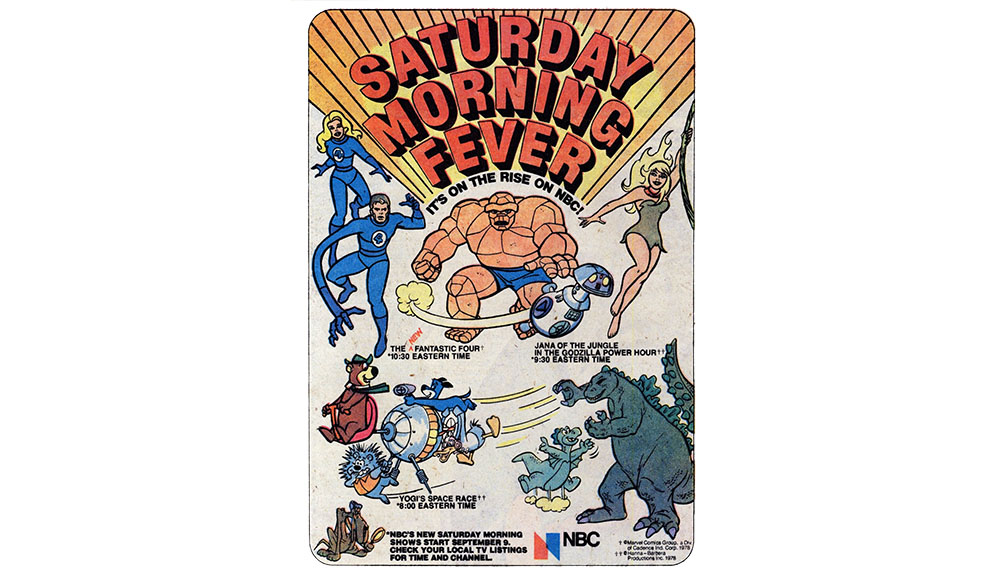
The Marvel comics for a given month generally feature the same advertising. As this was the first September 1978 book I read, I was paying close attention to the ads. One in particular hit me with a blast of nostalgia — a “Saturday Morning Fever” ad that was hyping new (at the time) NBC Saturday morning cartoons, including The Fantastic Four and Godzilla cartoons, which I used to love (and am still quite fond of). The ad also features Jana of the Jungle, a show I don’t remember at all, so I’m going to have to look that one up.
The Human Fly no. 16
When it’s at its best, this book is about the masked stuntman the Human Fly helping out working class folks and, while he’s at it, sticking it to the man. That’s the case here, with the Fly making plans to do a big stunt (waterskiing over Niagara Falls) to raise money for a local children’s hospital. But! One of his teammates gets kidnapped and the Fly and the rest of his team have to rescue her.
Turns out the kidnappers are hoping to stop the Human Fly’s big stunt because they want the hospital to go bankrupt so they can buy the property cheap and repurpose it as a high-end resort. Basically the perfect bad guys for a Human Fly book.
Aside from some stories that focus too much on stunts and not enough on protecting the blue collar community, my biggest gripe with this book is I’ve found the artwork to be hit and miss. I really dig the art in this issue, though, courtesy of penciler Bob Lubbers and inker Ricardo Villamonte. Good lettering, too, courtesy of Jim Novak.
I’ve been watching some classic TV shows lately (thanks, MeTV and other retro DirecTV channels!), and I’m realizing that The Human Fly has a 1970s television drama vibe. It’s kind of like a cross between The Fall Guy and The A-Team, even though those were both 1980s shows. If I were unexpectedly put in charge of Marvel’s TV division, I’d probably try to make a 1970s-set Human Fly TV show. Though, given the character’s (sort of) real life origins, I’m not sure what kind of copyright problems that might create.
Marvel Two-in-One no. 46
Because I obsess way too much about the lettering in these books (because I love the hand-lettering in old comic books), I occasionally notice that the lettering on the first page of a comic looks like it was done by a different letterer than whoever did the rest of the book. And, no offense to any letterers, but often the first page lettering looks a little more polished than the lettering on the other pages.
That’s the case with this issue of Marvel Two-in-One, at least according to the Fandom.com Marvel wiki. The credited letterer is “Shelly L.,” and the Marvel wiki says that’s Shelly Leferman. The wiki also credits Gaspar Saladino as a letterer on this issue, and I’m going to assume he did the first page.
Marvel Two-in-One was Marvel’s Thing team-up book in the 1970s, and this issue delivers kind of a perfect Bronze Age story, with the Thing going to Hollywood to complain to the powers-that-be about the Hulk’s TV show. At the time, there was a popular Incredible Hulk TV show in the real world, and Marvel was happy to take any opportunity to brag about that. The in-comic Hulk TV producers are trying to hire Karen Page to be on their TV show. I know Page is a character from the Daredevil comics, and I guess she tried her hand at acting at some point?
Some goons kidnap Page, planning to demand a ransom from the TV producers. But their plan is foiled when the Thing and Hulk (the “real” Hulk of the Marvel universe, not the TV Hulk of the Marvel universe Hulk TV show) get in a big brawl. Because Hulk is also in Hollywood because he’s also mad about the Hulk TV show. Of course, Hulk is mad about everything, that’s kind of his thing. But it’s funny that two of the most powerful characters in the Marvel universe are in Hollywood at the same time because they’re both mad about the same TV show.
As with generally having the same ads, all of the Marvel comic books for a given month share the same “Bullpen Bulletins,” which is kind of an in-house hype page. “Stan’s Soapbox” leads off the Bulletins, written by Marvel architect Stan “The Man” Lee. Lee mentions the then-new Japanese Spider-Man TV show and the Marvel Super Special color magazine series. Also, Lee says that there will be Super Special about actor/musician Shaun Cassidy at some point, and I don’t think that ever actually happened?
Other Bulletins tease upcoming stories in Marvel’s Godzilla and Defenders books, and there’s a mention of a Mighty Marvel Pin-Up Book which sounds like a big coffee table book. There’s also a dig at other comic book companies (I’m assuming DC Comics in particular) for raising the prices of their books. Marvel’s comics at this point were all sporting a big “still only 35¢” blurb on their covers.
Godzilla, King of the Monsters no. 17
The Fandom.com Marvel wiki has started listing Marvel Unlimited links where available. Of course, Marvel Unlimited doesn’t have the Godzilla books, which is understandable because of the complexities of the licensing agreement with Godzilla owners Toho studios, but it’s also a shame because Godzilla, King of the Monsters is, for my money, one of the great Bronze Age comic books. It’s also one of the most unusual, as it features Marvel’s traditional spandex-and-cape crowd interacting with a giant monster originally popularized in another medium.
This issue has something of a transitional vibe, wrapping up a few loose ends from the previous story arc and setting up the new story arc. But, oh my, that new arc is a doozy. One of the S.H.I.E.L.D. guys gets the bright idea to get Hank Pym, AKA Ant-Man, to use his shrinking technology to shrink Godzilla. Because Godzilla wouldn’t be so formidable if he was pocket-size, right?
I love this because it’s a novel approach to dealing with Godzilla, and it’s an approach only possible in a comic book where Godzilla and Ant-Man live in the same reality.
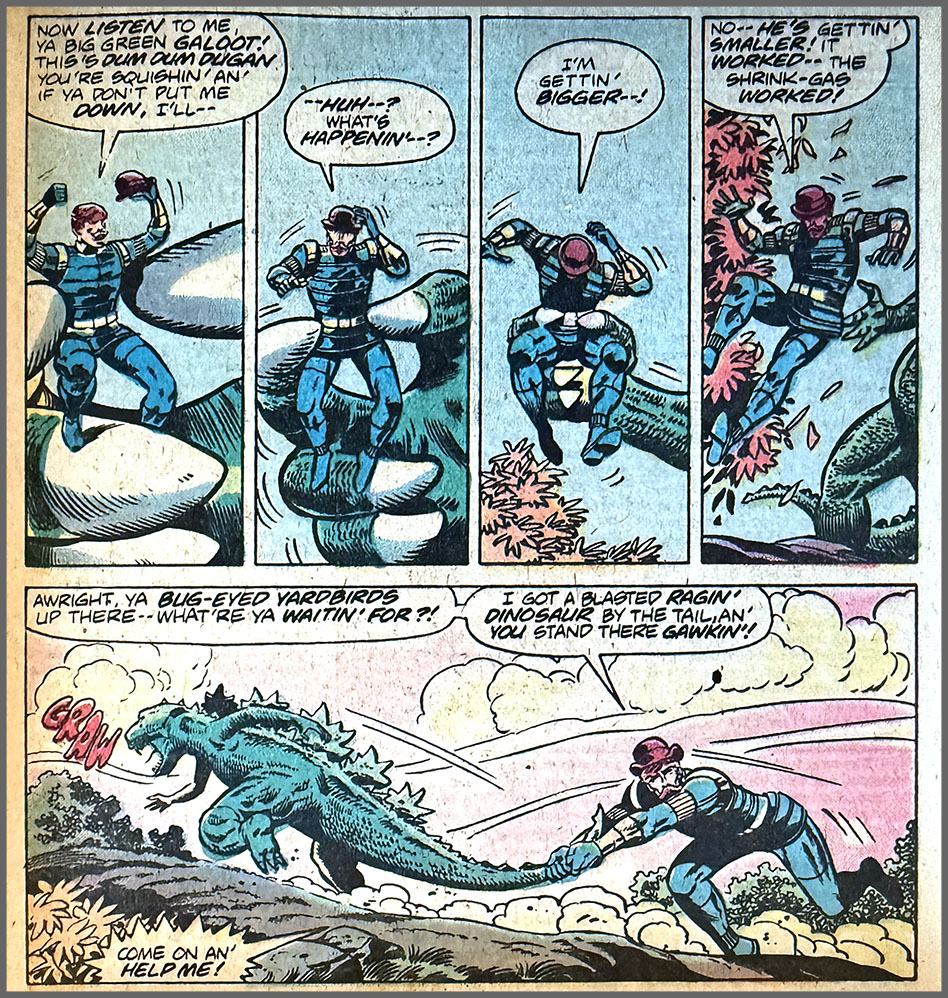
As usual, the artwork here, courtesy of Herb Trimpe, is top-notch. Check out this excerpt, which cleverly shows Godzilla shrinking by showing how Dum Dum Dugan gets bigger relative to Godzilla’s hand. (Godzilla had grabbed Dugan right before the S.H.I.E.L.D. guys hit Godzilla with the shrinking thing.)
Another Marvel TV show I’d like to see is S.H.I.E.L.D. versus Godzilla. Wouldn’t that be cool? I mean, it would probably be the most expensive TV show ever, due to the rights issues and all of the special effects involved. But it’d sure be fun. Oh, wait a minute. We could save a bunch of money by making the show in the style of 1970s kaiju movies, with a lot of miniatures and a guy in a Godzilla suit. That’d be even more fun.
Marvel Super-Heroes no. 77
Speaking of Herb Trimpe, he drew a lot of Hulk stories before he worked on Godzilla, including Incredible Hulk no. 125 from 1969. That story is reprinted in this issue of Marvel Super-Heroes. Aside from Trimpe’s excellent artwork, this story features Sam Rosen’s excellent lettering, so it’s a good looking book for sure.
Bronze Age Hulk’s outfit usually consisted only of ripped up purple pants. Which means that Hulk’s alter-ego, Bruce Banner, was often seen wearing only ripped up purple pants, because he wouldn’t usually have access to fresh clothes after changing back to Banner after being the Hulk. At one point in this story, some army guys get Banner to pilot a fancy new rocketship, and they don’t even give Banner a flight suit. So he’s piloting this technologically advanced rocket barefoot and shirtless. It’s pretty funny.
The army needs Banner to pilot the rocket to intercept a radioactive comet that might destroy all life on earth. I assume they need Banner for the job because the radioactivity won’t hurt him? Anyway, the rocket mission goes off basically without a hitch. But! The Absorbing Man attacks. Apparently the Absorbing Man was banished to outer space at some point by Thor’s dad Odin. He’d just been floating around until he hitched a ride on the comet, and then he hitched a ride on Banner’s rocket after Banner destroyed the comet.
After he sees the Absorbing Man, Bruce Banner understandably gets upset and transforms into the Hulk. So the rocket crashes and Hulk and Absorbing Man have a big fight. The Absorbing Man is pretty tough — he can absorb the properties of whatever he touches, so he can be tough like steel or granite. And he can absorb the properties of living things, too, so he absorbs some of the Hulk’s super strength.
Still, of all of Marvel’s heroes, the Hulk might be the toughest. In the long run, the Absorbing Man loses the fight. It’s like Hulk himself says during the fight: “Hulk doesn’t talk as pretty as some... or as much as most... but he can fight better than any!!”
Marvel Super Action no. 11
All of the books I read for Marvel Time Warp are retro, of course. But then sometimes I find an extra-retro book. I think Marvel Super Action qualifies as triple retro — it’s a 1978 reprint book, and the story it’s reprinting (Captain America no. 109) is from the 1960s, and that story is set during World War II. Well, at least part of the story is set during the 1940s. There’s a framing device set in the 1960s, with Captain America telling Nick Fury (agent of S.H.I.E.L.D.) his World War II-era origin story.
I don’t think I’d read an official comic book retelling of Captain America’s origin. I was pleasantly surprised to see it was very similar to the version portrayed in the Captain America: The First Avenger movie, right down to small details like the super soldier lab being hidden in an antique shop and a Nazi saboteur arriving in New York via U-boat. That said, the origin of Cap’s pal Bucky is very different than it is in the modern Marvel movies, since Bucky and Cap are contemporaries in the movies and Bucky is a kid sidekick in the original Captain America comics.
Week 36 Wrap-Up
So that’s six 35-cent books for the first week of September 1978. Total cost is $2.10, and that’d be about ten bucks in 2025 dollars.
Next time — Not sure how soon it will happen, but eventually I’ll be back with a look at Marvel’s books from the second week of September 1978.
Discussion about this post
Add a comment